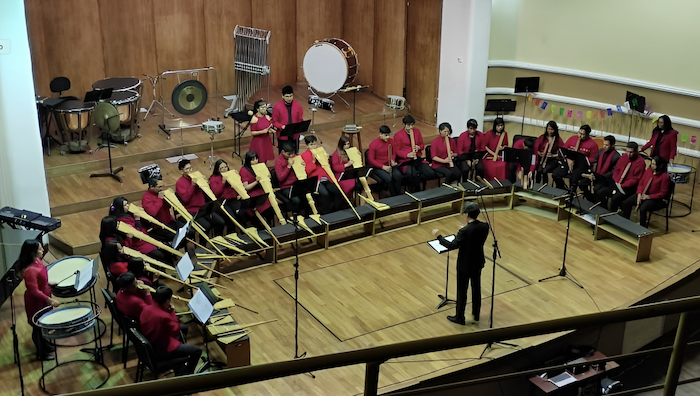
In its second concert at klub katarakt, the Orquesta Experimental de Instrumentos Nativos (OEIN) presents four works that approach Indigenous instruments and musical practices not as fixed traditions, but as active fields for contemporary experimentation. Bringing together music by Tania Rubio, Raven Chacon, Matías Rosales, and Carlos Gutiérrez, the programme moves between territory, notation, visual representation, spatial organisation, and collective forms of sound-making.
Across these works, the score itself becomes a site of inquiry. Conventional notation is displaced, expanded, or confronted with other systems of representation: field recordings and instrumental mappings derived from ecological research; graphic signs whose interpretation exposes assumptions about Indigenous identity; polygonal and circular structures translated into rhythm and gesture; and networks of panpipe articulations conceived through the Aymara idea of ch’ipa, an interwoven structure held together through tension and interdependence.
The programme also explores different relationships between sound and space. In Entre la Selva y el Altiplano, Tania Rubio draws on research and recordings made in two radically different Bolivian ecosystems, transforming environmental listening into an immersive instrumental landscape. Raven Chacon’s …lahgo adil’i dine doo yeehosinilgii yidaaghi turns visual signs and the act of interpretation itself into compositional material, questioning expectations projected onto the work of an Indigenous composer. Matías Rosales transforms pedagogical tools developed through his work with OEIN into a real-time visual system for producing intricate rhythmic and gestural relationships. In Ch’ipa X, Carlos Gutiérrez distributes panpipe constellations through the performance space, creating a sonic network in which proximity, distance, and resonance continually reshape the music.
What connects these very different works is not a single idea of “Indigenous music”, but a shared questioning of how music can be organised and transmitted: how a sound becomes part of a collective, how knowledge can take the form of a diagram, a landscape, a symbol, a gesture or an interlocking rhythm, and how listening changes when these relationships are made audible.
Here, the OEIN functions less as a conventional orchestra than as a mutable collective instrument. Its native instruments, their particular acoustics, and the musicians’ long experience of playing together become the ground from which different compositional systems can emerge, collide, and be reinvented.